

The quaint coziness of the cell begins to enclose. The light flickering as if the bill hadn’t been tendered and the night was about to be a dreary compromise. A man of the cloth sits in the darkness barely able to be seen from the shadows. One hand on the table and another on his knee, as a slow tap emanating from his heel marks the seconds that drift away. Opposite him is a young lad with a day old, yet tattered prison issued jumpsuit. The look in his eyes is one of the inevitable, one of knowledge, that his time has finally come. Yet despite his disposition, he is strangely the best dressed in this space. The temperature shifts, and without so much as a foretelling, the young figure looks up and emanates a smile that would make the underworld quiver in fear. In that moment, you see everything. The charm, the calculation, the complete and total absence of remorse.
Then the film begins. And it only gets worse. In the best possible way.
That is the opening of How to Make a Killing, which arrived in theaters nationwide on February 20, 2026, and has spent the four days since becoming the most talked-about film of the year. And what it tells you, in under thirty seconds, is exactly what kind of movie you are in for: one that knows its hero is a killer, wants you to know it too, and is betting everything on the fact that you will not care.
It wins that bet. Handily. Repeatedly. And with considerable style.
The Dark Comedy That Bites Back
Director John Patton Ford didn’t set out to make a thriller. Instead, he set out to make a comedy, specifically a loose American reimagining of the 1949 British classic Kind Hearts and Coronets, in which a young man murders his way through a noble family to claim a title. That film was English in its restraint. This one is American in its appetite.
The premise arrives with the confidence of a full house. Becket Redfellow (Glen Powell) was disowned before he drew his first breath. His mother chose to keep him rather than surrender him to her ruthless, billionaire family, and so she raised him in working-class New Jersey with archery lessons, piano scales, and the complete works of Dickens, grooming an aristocrat in a tenement. On her deathbed, she handed him his inheritance: not money, not property, but a list of names.
Six Redfellow heirs stand between Becket and the family fortune. Consequently, Becket does what any reasonable, charming, and entirely guilt-free person would do. He starts working through the list. Furthermore, the film has a real thesis running beneath the body count: that wanting more is not a flaw but a virtue, that ambition justifies almost anything, and that the distance between admirable drive and criminal hunger is mostly a matter of whose money you’re after. Becket Redfellow is the American Dream with the mask off. He is not a cautionary tale. He is a mirror.
The comedy works through antithesis: the more terrible Becket’s actions, the more the audience leans in. However, Ford never lets us off the hook. The laughter we produce watching Becket scheme is the film’s real subject. Above all, that laughter implicates us in something the film is too polite to name outright.
“It’s a dilemma we all share. How far we’ll go in life to get something we’re convinced will make us content.” John Patton Ford, Director
Glen Powell Has Never Been Better
Glen Powell is a movie star. Top Gun: Maverick confirmed it, Hit Man refined it, and Anyone But You made it a matter of public record. But stardom, as any student of Hollywood knows, is not the same as range. How to Make a Killing is where Powell proves the difference.
His Becket is charming without being harmless, funny without being safe, and convinced of his own righteousness in a way that is, paradoxically, the most dangerous thing about him. Rather than brooding or monologuing, he moves through the film like a man who has done the moral math and found the numbers satisfying. The film never quite lets us decide whether he’s right. That tension is where Powell lives for 105 minutes, and he never once blinks.
As a result, the physical transformation across the film becomes its own argument. Powell wears 35 different costumes, each one calibrated to the world Becket is infiltrating: the threadbare jacket of a working man, the open collar of a downtown artist, and finally the Brioni suit of someone who has arrived exactly where he always believed he belonged. By the end, you cannot imagine him wearing anything else. Neither, you suspect, can he.
“Some people will say this movie is about revenge. It’s really a movie about ambition. What’s most fun about Becket’s trajectory is that there’s no sense of guilt on his part.” Glen Powell
The Ensemble: Everyone Is Playing to Win
The Redfellow heirs are, as Ford cheerfully puts it, a murderer’s row of talent. Each one is a different answer to the same question: what does inherited wealth do to a person over time? Moreover, each answer is played by someone who treats the material with exactly the seriousness it deserves.
Ed Harris plays patriarch Whitelaw Redfellow, barely glimpsed until the final act but felt in every scene before it. He is a man so accustomed to being right that wrongness has become, for him, a category error. Harris plays him not as a villain but as a force of nature: indifferent, immovable, and utterly sure of himself. In 2026, that particular kind of certainty needs no further ornamentation to be terrifying.
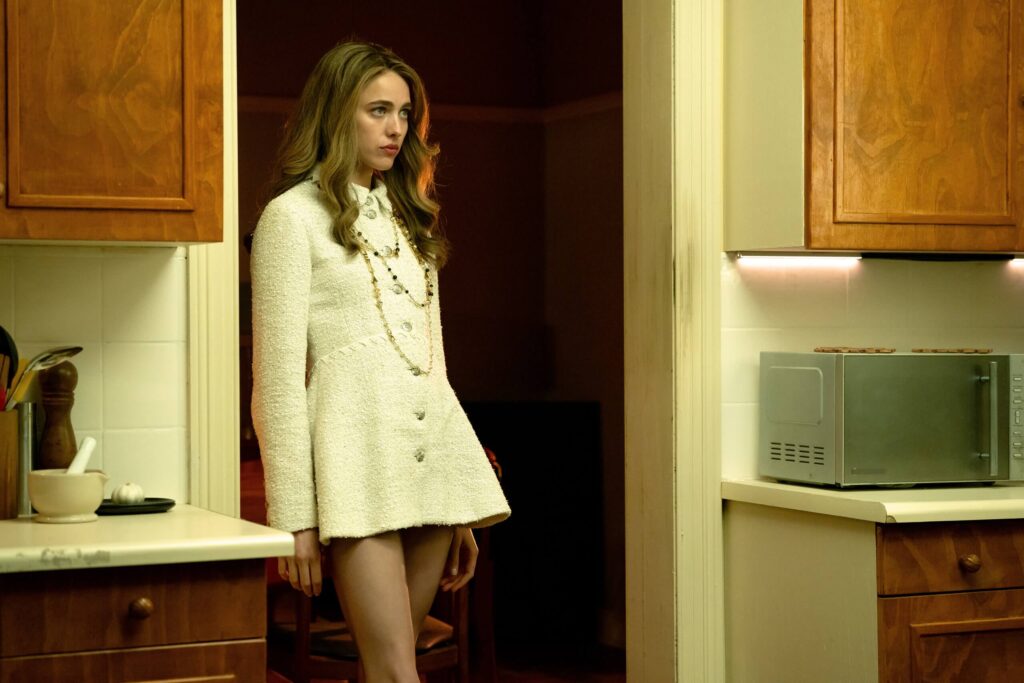
Margaret Qualley arrives mid-film as Julia, Becket’s childhood obsession now weaponized into something altogether more dangerous. Coming off a Golden Globe nomination for The Substance, Qualley brings cold intelligence to a role that lesser films would have made merely decorative. Julia knows exactly what Becket is doing. Indeed, she finds it, among other things, attractive, which tells you everything you need to know about both of them.
In contrast, Jessica Henwick plays Ruth, the film’s moral center and its only true civilian. She is warm, perceptive, and entirely unaware of what she has wandered into. Henwick plays her without sentiment, which is precisely why she matters. Meanwhile, Zach Woods, Topher Grace, Bill Camp, and Raff Law give the doomed heirs enough humanity to make the comedy sting. You will laugh. You will feel something after.
The Craft Behind the Comedy
Great dark comedy is not, as it might appear, an absence of craft. Rather, it is craft working so precisely that the machinery becomes invisible. On every technical level, How to Make a Killing earns that invisibility.
Cinematographer Todd Banhazl, whose work on HBO’s Winning Time earned two Emmy nominations, gives the film a visual grammar that tightens incrementally as Becket descends. Consequently, what begins as open and expansive slowly becomes enclosed and inescapable. The camera does not comment on Becket’s choices. Instead, it simply closes in, the way consequences do.
“This movie takes multiple genres and flips them on their head, from romantic comedy and film noir to family drama and psychological thriller. It’s big, sexy, and hilarious. A little dangerous, but very exciting.” Glen Powell
Production designer Christian Huband built two worlds with extraordinary precision. First, there is Becket’s modest New Jersey childhood home: specific, lived-in, and real in the way that only deprivation makes a place feel. Then there is the Redfellow mansion on Long Island’s North Shore, a Mock Tudor estate whose exterior facade took eight full weeks to construct and whose every surface communicates the Gothic weight of old money. The distance between those two sets is the film’s entire emotional argument, made physical and unavoidable.
Additionally, composer Emile Mosseri, Oscar and Grammy nominated and known for Minari and The Last Black Man in San Francisco, provides a score that practices emotional litotes: it says less than each scene deserves, which makes you feel more than you expected. That restraint, ultimately, is what gives the film its unsettling undertow.
Why A24 Was the Only Home for This Film
There is a specific kind of film that only A24 makes: morally complex, technically rigorous, and stubbornly resistant to being easily consumed or comfortably forgotten. Similarly, there is a specific kind of audience that A24 trusts, one willing to sit with an uncomfortable idea and find it, nonetheless, entirely worth the discomfort.

How to Make a Killing fulfills that compact at the highest level the studio has managed in years. The film carries genuine weight without ever becoming heavy, genuine darkness without ever losing its nerve, and a genuine thesis without ever mistaking itself for a lecture.
John Patton Ford announced himself with Emily the Criminal in 2022, a film about the lengths ordinary people go to when the system shuts them out. How to Make a Killing asks the same question from the opposite direction: what happens when the system always had a place for you, and someone took it before you arrived? The answer, Ford suggests, is very dark comedy. And the answer works brilliantly.
Should You See How to Make a Killing?
Yes. Immediately and without reservation.
What separates How to Make a Killing from the films around it is not its premise or its performances, remarkable as both are. Rather, it is the film’s refusal to let you watch from a safe distance. Instead of entertaining you, it recruits you. Rather than telling you a story, it makes you a participant in one. By the time the credits roll, you will have laughed more than you expected, thought more than you planned, and left carrying something you did not arrive with.
Ultimately, that is the oldest trick in the dark comedy playbook: give the audience the rope, watch them enjoy holding it, and never quite let them forget that they picked it up willingly. How to Make a Killing executes that trick with rare precision and considerable style.
Becket Redfellow, one suspects, would find the whole thing deeply satisfying.
Learn more at a24films.com
Related: More Movie Reviews | Entertainment
