
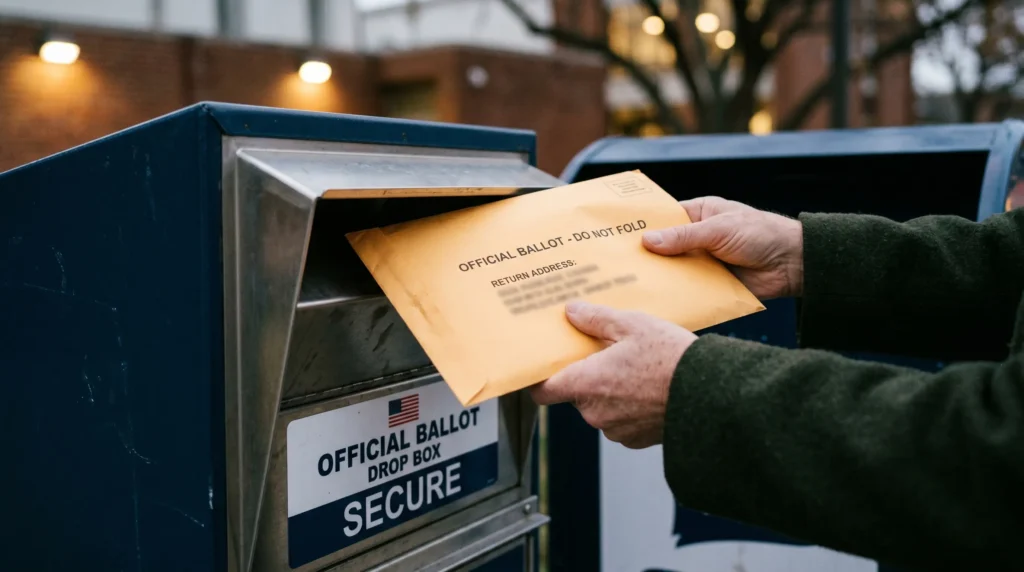
Mail ballots now sit inside a logistics fight. On September 14, the Supreme Court refused to let a new Postal Service rule take effect before the midterms. That order left in place a block the First Circuit had upheld four days earlier. The rule would turn envelopes and recipient lists into gatekeepers. Under the Constitution, however, election rules belong to states and Congress.
The Court’s order said the government was unlikely to win its challenge to the injunction. Justices Samuel Alito and Clarence Thomas dissented, as SCOTUSblog reports. Earlier, a three-judge panel in Boston had kept Judge Indira Talwani’s block in place, according to Reuters and Al Jazeera.
So November is settled, but the larger question is not. The barcode-and-list rule turns postal delivery into election work. The executive branch cannot rewrite ballot logistics when the Constitution hands election rules to states and Congress.
Mail Ballots Rule Snapshot
Rule features: Recipient lists plus unique barcodes
USPS power claimed: Refuse noncompliant mail ballots
Injunction: Judge Indira Talwani
1st Circuit: Refused stay on Sept. 10, 2026
Supreme Court: Denied stay on Sept. 14; Alito and Thomas dissented
What the Mail Ballots Rule Actually Requires
The Postal Service finished the rule in late August. The final rule, Ballot Mail for Federal Elections, appears at 91 Fed. Reg. 54966, as cited in an ACLU letter to the Supreme Court. States must give USPS lists of voters set to get ballots by mail. Outbound and return envelopes must carry unique barcodes. USPS may refuse to move mail-in or absentee ballots that fail the new standards. It may also refuse ballots for voters who do not appear on the lists.
On the surface, that design looks like mail standards. In practice, though, it ties delivery to election paperwork. A missing barcode becomes a ballot risk, and a list mismatch becomes a delivery risk. Either way, postal staff end up deciding whose ballot moves.
All 50 states allow some form of mail voting, according to Al Jazeera and the Movement Advancement Project. Reuters and Al Jazeera both report that 29 states let voters ask for a mail ballot with no special reason, while eight states run elections entirely by mail. As a result, a federal barcode-and-list plan hits a national practice, not a niche channel.
Timing raised the stakes. Midterms land on November 3, and Al Jazeera notes less than eight weeks remained when the First Circuit ruled. North Carolina had already started mailing ballots, PBS reported. Printing new envelopes is not a weekend task, and neither is building a scan system at national scale.
So the rule was never a small tweak in a quiet month. It was a new gate on mail ballots weeks before a national vote. That is why courts treated speed as part of the harm.
Why Judge Talwani Blocked the Mail Ballots Plan
Judge Talwani issued the block after voting-rights groups and Democratic-led states sued, as Reuters reported on September 4. According to Reuters, she found the rule likely unlawful and likely at odds with the Constitution’s grant of election power to the states. She also saw a real risk of cutting voters out.
Al Jazeera quotes the appeals court on her fact findings. Some states could not reprint compliant envelopes in time. Meanwhile, the digital portal USPS needed to scan tens of millions of ballot envelopes was not yet working. In other words, chaos before November 3 was not a slogan. It was a finding the panel said no evidence disputed.
Plaintiffs include the League of Women Voters and allied groups. Al Jazeera also notes a separate suit from 24 states plus the District of Columbia. California Attorney General Rob Bonta praised the First Circuit result in a state press release, calling it a rejection of the latest “attempt to disrupt mail voting.”
The administration had won an earlier round at the Supreme Court. The high court lifted a prior Talwani block that stopped the rule before it was finished. That history matters. Still, it did not erase the new findings about rollout risk once the rule became final.
The district court made detailed findings about the chaos and widespread disenfranchisement that would occur between now and November 3 should the Final Rule take immediate effect.
First Circuit panel, as quoted by Al Jazeera
The First Circuit Frame on Mail Ballots Power
The Justice Department cast the rule as a narrow mail measure. In its Supreme Court filing, DOJ said the rule imposes “only modest requirements on the use of the federal postal system” and “does not regulate state administration of elections,” as Law Dork reports. Democracy Docket and Al Jazeera describe the same “modest” framing before the First Circuit. On that view, envelope design is the narrow federal piece.
The panel rejected that trim reading. “To label this Final Rule as merely a ‘modest’ regulation of the mails is to focus on the trees while ignoring the forest,” the judges wrote, as quoted in a Hodgson Russ legal alert. Under the Constitution, states and Congress regulate elections. The executive branch does not get to rewrite that map through postal rules.
Risk also weighed heavily. The court saw no error in Talwani’s view that the rule would likely cut millions of voters out. Meanwhile, gains against fraud looked minimal on the record. That balance is the block in plain form: huge downside, thin upside.
Some critics will call the lower-court rulings partisan. However, the Supreme Court reached the same outcome with only two dissents, which makes that charge harder to sustain.
Words like “modest” do a lot of work in DOJ briefs. The panel looked past the label. Voter lists paired with refusal power read as election control, not postage polish.
Whistleblower Alarm and Rush Claims
A separate warning entered the public file in early September. Senator Richard Blumenthal released an anonymous federal whistleblower statement on September 1, as PBS and Al Jazeera report. According to PBS, the whistleblower said USPS was building a complex system in about three months instead of the usual year or more. One scanning error, the statement warned, could sink a whole batch of ballot envelopes.
Anonymous claims are not court findings. Even so, they match the district court’s worry about a portal that is not ready. When logistics systems are unfinished, every barcode and every list line becomes a choke point. Refusal power then turns small errors into mass losses.
The agency’s defense is that power over mail standards is real. The legal question is whether these standards crossed into election work.
An executive order sits behind the rule. President Trump signed an order in March calling for tighter mail-voting rules. He has long attacked mail voting and pushed the false claim that mail ballots cost him the 2020 election, as Axios and Reuters both report. The Brennan Center ties recent mail-voting limits to those false fraud claims. Motive fights will dominate cable. Courts, by contrast, have to police the text of the rule and the Constitution.
The Fair Counter on Mail Ballots Rules
DOJ’s modest-rule theory is the cleanest counter. Mail must move under postal standards, and unique barcodes can aid tracking. Fraud prevention is also a real interest even when fraud rates are debated. Moreover, USPS has long-running power over how mail is addressed and processed.
Two justices went further. Justice Alito, joined by Justice Thomas, wrote that USPS holds broad rulemaking power under federal postal law. He also called the states’ core claim a “Hail Mary pass” that “rarely succeeds,” as the order and SCOTUSblog both show. Justice Brett Kavanaugh agreed to keep the block, yet he suggested the rule likely fits within USPS authority. His problem was time, since election officials could not reasonably carry it out before November.
Those points deserve airtime. Still, they collide with refusal power tied to state-supplied election lists. When USPS may decline to move a ballot because a name is missing from a federalized list, delivery becomes eligibility screening. That is election work wearing a logistics badge.
Fraud talk also needs care. Preventing fraud is a valid goal. However, the record before these courts did not show gains that matched the scale of likely ballot loss. A thin fraud gain cannot justify a thick logistics shock on this timeline.
What the Mail Ballots Fight Decides Next
For November, the answer is in. Mail ballots will move under existing state designs, and the rule will not apply to the midterms. Yet the core dispute remains open, as county officials and SCOTUSblog note. Courts still have to decide whether USPS has the power to write this kind of rule at all.
Kavanaugh’s concurrence shows why that matters. If a future Court treats timing as the only flaw, the rule could return for later federal elections with more lead time. In that case, the power question becomes the whole fight.
Federalism is the durable stake. Congress and the states share the job of setting election rules, while the executive runs the Postal Service. The barcode-and-list rule tries to blend those lanes. Courts are deciding whether that blend is modest mail policy or a rewrite of who runs elections.
Voters who rely on mail ballots should watch the merits case, not the cable spin. After all, delivery rules decide whether a sealed envelope counts as a vote in transit or a rejected package.
The thesis resolves on that line. Mail ballots are not only envelopes. They are votes in transit. A rule that conditions delivery on federal lists and unique barcodes turns postal logistics into election work. The courts kept that experiment off the table for November. The Constitution’s grant of election rules to states and Congress is why the next round matters too.
