

The road to the 2028 Summer Olympics is becoming clearer, and significantly broader. LA28 organizers have announced six additional stadiums across the United States that will host matches for the Olympic soccer tournaments, signaling a nationwide celebration rather than a single city showcase.
As anticipation builds, registration for the LA28 Olympic Ticket Draw remains open through March 18, offering global fans an early opportunity to secure access to one of the decade’s most anticipated sporting events.
Ultimately, the tournaments will culminate at the legendary Rose Bowl Stadium, where the men’s gold medal match is scheduled for July 28, 2028, followed by the women’s final on July 29. However, the journey toward those defining moments will now stretch from coast to coast.
A Tournament Designed for a Nation
Rather than concentrating matches within Southern California, LA28 is embracing a distributed model that reflects both the scale of the United States and the global reach of soccer.
The newly announced host metropolitan areas include New York, Columbus, Nashville, St. Louis, San José, and San Diego. Collectively, these cities represent established soccer markets with modern infrastructure and deeply engaged fan bases.
Organizers collaborated closely with Soccer United Marketing, the commercial arm of Major League Soccer, to evaluate venues capable of meeting rigorous international standards. Priority was given to purpose built stadiums, although each location was also assessed for community impact and operational readiness.
“Bringing Olympic Football matches to stadiums across the United States means more fans will witness this global event and experience the Olympic spirit firsthand.” Shana Ferguson, Chief of Sport and Games Delivery Officer, LA28
Importantly, the competition is expected to progress geographically from east to west as teams advance. This strategy aims to minimize travel strain while supporting athlete recovery between matches.
Additionally, organizers are exploring an extended competition window that could allow preliminary matches to begin before the Opening Ceremony. If confirmed, this adjustment would further prioritize player health while maintaining competitive integrity.
World Class Stadiums Take Center Stage
The selected venues highlight both legacy franchises and emerging soccer hubs, underscoring the sport’s accelerating growth across North America.
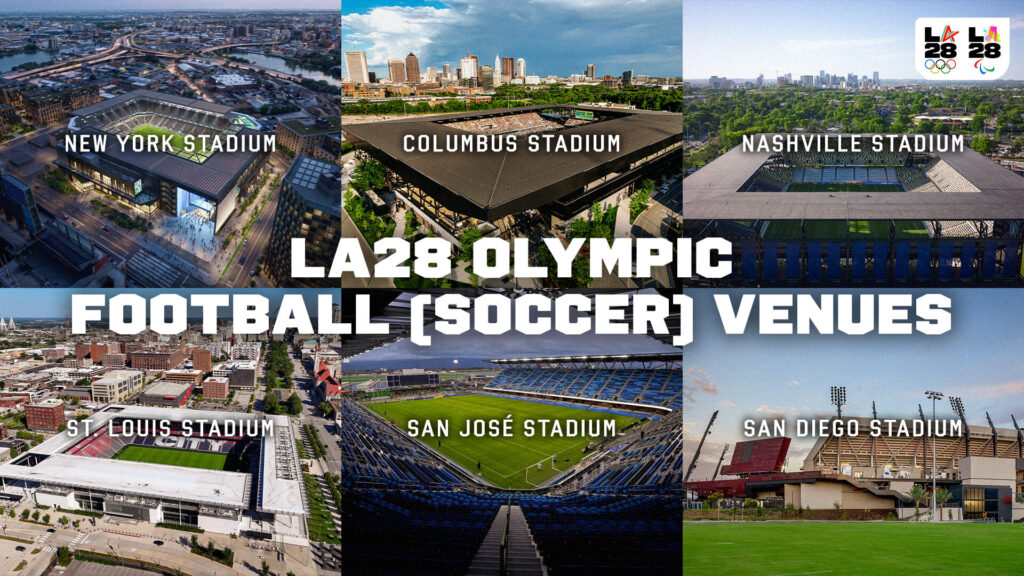
New York’s future soccer stadium, set for completion in 2027, is poised to introduce Olympic competition to one of the world’s most influential sports markets. Meanwhile, Columbus continues its reputation as a foundational American soccer city.
Nashville and St. Louis reflect the sport’s expanding cultural footprint in the central United States, while San José and San Diego reinforce California’s longstanding connection to the global game.
Notably, each stadium was selected not only for technical capability but also for its ability to energize local communities. The objective is clear: transform Olympic soccer into a shared national experience rather than a regional attraction.
A Defining Moment for Women’s Soccer
Perhaps the most historic announcement lies within the tournament structure itself. For the first time in Olympic history, the women’s soccer competition will feature more teams than the men’s tournament.
The women’s field expands to 16 teams, while the men’s competition adjusts to 12. Consequently, LA28 will become the first Olympic Games in which every team sport includes at least as many women’s teams as men’s.
This milestone signals more than numerical parity. Instead, it reflects a broader institutional shift toward elevating women’s sports on the world stage.
The decision also arrives during a period of unprecedented commercial growth for women’s soccer, where attendance records, sponsorship deals, and media rights continue to accelerate.
LA28 is setting a new benchmark for gender equity while positioning women’s soccer as a central pillar of the Olympic movement.
Therefore, the 2028 Games may represent a generational turning point, one capable of influencing investment and participation long after the closing ceremony.
Tickets, Timelines, and What Comes Next
While venue announcements provide clarity, several key details remain forthcoming. The full match schedule, including dates and stadium assignments, is expected before the first ticket release in April 2026.
Specific team matchups will follow later, pending qualification progress and the official tournament draw.
For now, the LA28 Ticket Draw offers the earliest pathway for fans hoping to witness Olympic history in person. Registration requires no purchase, although eligibility restrictions apply and availability is not guaranteed.
Beyond soccer, the broader LA28 vision promises a sweeping celebration of sport, culture, and human potential. More than 15,000 athletes are expected to compete across a diverse collection of venues stretching from coastal arenas to iconic entertainment landmarks.
Los Angeles will also become only the third city to host three Olympic Games, joining an exclusive historical tier while simultaneously staging its first Paralympic Games.
Equally notable, LA28 plans to operate without constructing new permanent infrastructure, marking the first Olympics since 1948 to adopt such an approach.
As momentum builds, one reality is already apparent. The 2028 Olympic soccer tournaments will not belong to a single city. Instead, they will unfold across an entire nation, inviting millions to participate in a shared global moment.
