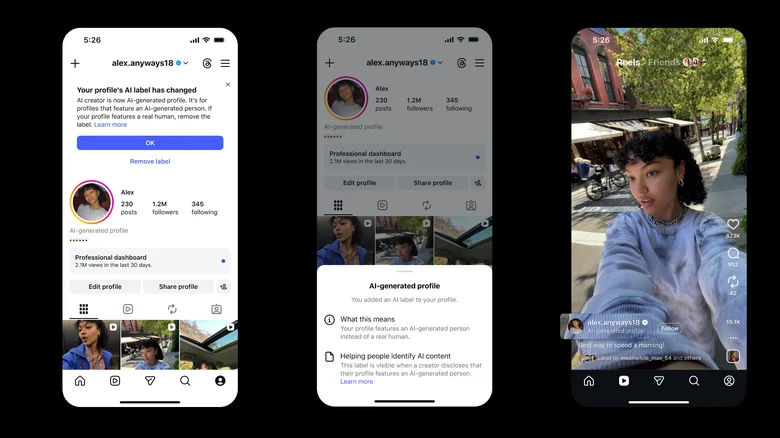
Yes, the headline is true. On August 31, 2026, Instagram announced a rule change for accounts built around AI-generated people. Those accounts now need to switch on a badge called “AI-generated profile.” Skip it, and Instagram says your reach shrinks. So the “or else” part is not hype. It is the actual policy, and it is the first time the platform has attached a real cost to hiding a synthetic persona.
But the new Instagram AI label is narrower than most people assume. It does not touch AI slop in general. It targets one thing: fake humans who pass as real ones.
What the new Instagram AI label actually does
Instagram is renaming a badge it already had. Back on May 4, 2026, the app began testing an optional “AI creator” tag. That version was a catch-all. It read like a note about tools, and creators could ignore it with no penalty.
The new version is tighter. Instagram AI label wording now points at the person on screen, not the software behind the post. The badge sits on the profile itself. It also rides along beside posts and Reels wherever they show up in the app.
There is one small wrinkle. If a single post already carries the older “AI info” tag, that per-post tag wins. The profile badge does not double up on top of it.
Creators who already toggled on the old AI creator tag will see the new name appear. Then they can confirm it, or remove it if their account no longer fits. And here is the carrot: anyone who adds the badge on their own keeps full distribution. Instagram is explicit that voluntary disclosure costs you nothing.
Who needs the Instagram AI label, and who does not
This is where most of the confusion sits, so read it slowly.
The badge applies to accounts that regularly post content featuring an AI-generated person instead of a real human. Think of a synthetic model with a name, a face, a backstory, and a follower count. That is the target.
The badge does not apply to creators who simply use AI in their workflow. Instagram named the carve-outs directly. Editing photographs, polishing captions, generating backgrounds, or building graphics with AI will not trigger the requirement. In other words, the Instagram AI label is about identity, not tooling.
Announced: August 31, 2026, on the Instagram Creators blog
Old name: AI creator label, tested from May 4, 2026
New name: AI-generated profile
Who it covers: Accounts featuring an AI-generated person rather than a human
Penalty for skipping: Loss of eligibility for recommendations
Appeal route: Account Status in Instagram settings
Note what is missing from that box. The announcement mentions no removal and no ban anywhere.
What happens if you ignore the Instagram AI label
The punishment is quiet, which arguably makes it worse. Unlabeled accounts that Instagram detects stop being eligible for recommendations. So the posts keep existing for followers, but they stop surfacing to strangers.
For an influencer account, that is the whole ballgame. Growth comes from people who do not follow you yet. Cut off that supply, and the account slowly freezes in place.
Instagram says it will notify accounts it flags. Creators can then check Account Status to see whether limits landed. From there, two doors open. Either add the badge and restore eligibility, or appeal if the call looks wrong.
Instagram also admitted something useful: its systems will not always be right. An Instagram spokesperson told Engadget that unlabeled accounts “may soon see limits to their reach.” That phrasing matters. “May soon” reads like a phased rollout, not a switch flipped overnight. No firm start date has been published.
Why Instagram moved on AI profiles now
Pressure had been building for months before the Instagram AI label arrived, and it came from reporting rather than regulators.
In June, The Guardian found brands quietly using AI-generated influencers to fake customer testimonials. Some creators making that content were reportedly asked to sign NDAs. One fashion brand deleted its photos after reporters asked questions, partly because a model in the shot had an extra finger.
Then came July. The New York Times reviewed hundreds of ads and found synthetic doctors and wellness gurus pushing supplements, often with fake diplomas on fake office walls. Older women appeared to be the main target.
Meanwhile Wired traced a network of apparently AI-generated male influencers promoting a gay dating app, with some accounts sliding into DMs to drive signups.
Meta was also having a rough summer for trust. In July it pulled an image tool after users objected to their likenesses being used. In August it settled with 29 states for $18 billion over harms to minors.
Instagram head Adam Mosseri warned at the start of 2026 that “authenticity is becoming infinitely reproducible.” He predicted platforms would face rising pressure to label AI content, and that they would get worse at spotting it over time.
Read alongside the new rule, that memo looks less like commentary and more like a roadmap.
The Europe factor behind the Instagram AI label
Instagram framed the update as a response to user feedback. Still, the timing deserves a raised eyebrow.
On August 2, 2026, Article 50 of the EU AI Act began to apply. Those transparency rules require clear disclosure when content is a deepfake, and they require machine-readable marking of synthetic media. The European Commission published final guidance on July 20, 2026. Roughly 190 organizations had signed the accompanying Code of Practice by the end of that month.
Penalties reach 15 million euros or 3 percent of worldwide annual turnover, whichever is higher. Those rules reach any company serving EU users, wherever it is based.
So Instagram rolled out a profile-level Instagram AI label four weeks after Europe switched on mandatory disclosure. Officially, the two are unrelated. Practically, one makes the other much cheaper to comply with.
What the Instagram AI label leaves untouched
Here is the honest limit of the news. Instagram is not cracking down on AI content generally.
Meta actively encourages people to make AI media, and it keeps shipping tools that do exactly that. Fully synthetic landscapes, animals, memes, and product shots stay untouched. Only synthetic humans posing as real creators fall inside the rule.
Other platforms have taken different routes. LinkedIn began suppressing formulaic AI posts in May 2026. Snapchat made wholly AI-generated videos ineligible for Spotlight recommendations starting August 2, 2026. Pinterest added labels plus a slider so users can see fewer AI pins. TikTok requires disclosure and lets people dial AI down in their feed.
Instagram picked the narrowest lane of the bunch. Critics will call that half a fix, and they have a point.
How Instagram plans to catch unlabeled AI accounts
The company has not explained its detection method, which is a notable gap.
Meta already reads industry-standard provenance signals on upload, including C2PA content credentials and IPTC metadata. Those signals power the existing “AI info” tags. But metadata gets stripped easily, and screenshots defeat it entirely.
Profile-level detection is a harder problem anyway. It requires judging a persona across many posts rather than checking one file. Mosseri himself predicted platforms would lose ground here as models improve. He has floated a different approach: fingerprint real media instead of chasing fake media.
Until that exists, appeals become the safety valve. And the volume of appeals will tell us how accurate the classifier really is.
What the Instagram AI label means for brands
The virtual influencer economy is no longer a curiosity. Lil Miquela, launched in 2016, sits around 2.5 million followers with campaigns for Prada and Calvin Klein behind her. Aitana López, built by Spanish agency The Clueless, reportedly peaked near 10,000 euros a month, though her creators told Euronews an average month runs closer to 3,000.
For marketers, the badge is a gift. Until now, vetting whether a “creator” existed took detective work. Soon a glance at the profile answers it.
For creators running synthetic personas, the calculation flips. Disclosure used to feel like admitting a weakness. Now it protects your distribution. Hiding is the risky move.
The questions Instagram has not answered
Several big gaps remain, and they matter.
Instagram gave no rollout date and no geographic detail. It has not defined how much of a face must be synthetic before an account qualifies. Partial edits and heavily filtered humans sit in a grey zone. AI avatars built from real, consenting faces sit there too.
Meta also has not announced matching enforcement on Facebook or Threads, even though the same synthetic wellness ads run there. And nothing in the policy addresses the ads themselves, which is where the supplement scams actually live.
So treat this as a first step rather than a solution. The Instagram AI label draws one clear line: if the person is fake, say so. Whether Instagram can enforce that line is the story worth watching next.

