
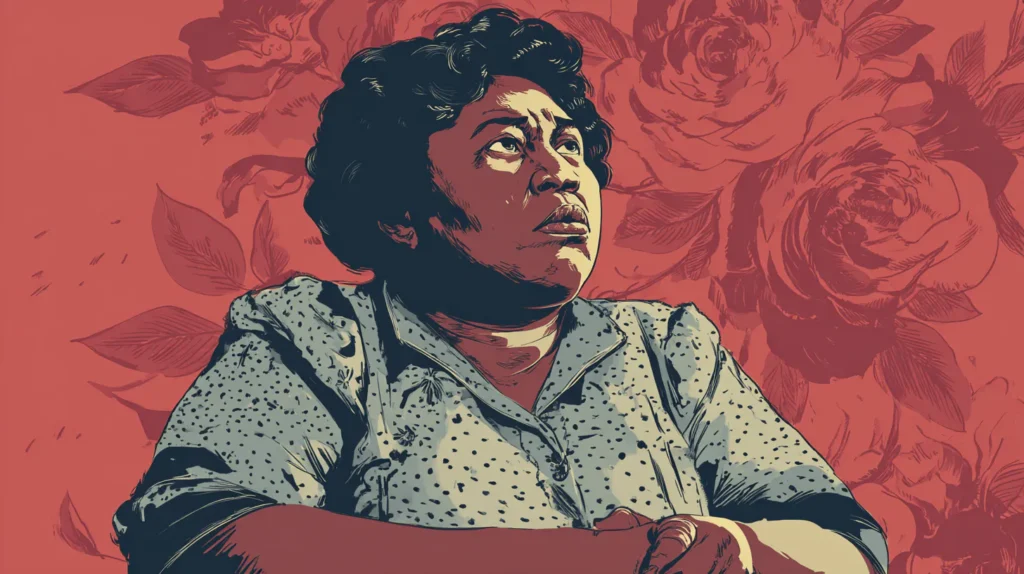
There is a word that doctors in Mississippi reached for in the middle of the twentieth century when they quietly ended a Black woman’s ability to have children without telling her. They called it a Mississippi appendectomy. The phrasing was deliberate. An appendix is something you remove without ceremony, something nobody mourns. You wake up, heal up, go home. Nobody calls it a theft.
In the summer of 1961, Fannie Lou Hamer went into North Sunflower County Hospital to have a small uterine tumor removed. She was forty-three years old, a sharecropper from Ruleville, the twentieth child of two people who had worked cotton on another man’s land their entire lives. Hamer woke from surgery and went home. She did not learn what the doctor had also done until it was already finished.
He had performed a hysterectomy without her knowledge and without her consent. She would never carry a child.
The Twentieth Child
Fannie Lou Townsend was born on October 6, 1917, in Montgomery County, Mississippi. Her parents, Jim and Ella Townsend, were cotton sharecroppers. She was the last of their twenty children, and the family needed every set of hands they could put to work. By age six, Fannie Lou was in the fields alongside her parents. By twelve, she had left school permanently to work full time.
Her formal education stopped at the sixth grade. What grew in its place was something no classroom could have taught. She had a voice that could fill a church to the rafters and a moral clarity that would eventually rattle the White House. Hamer knew how to convert injustice into motion, and no amount of violence would change that.
She married Perry Hamer in 1944. Everyone called him Pap. They settled in Sunflower County on a plantation owned by B.D. Marlowe, where Pap worked as a tractor driver and Fannie Lou eventually became the plantation’s timekeeper. They lived there for eighteen years. They wanted children. Her pregnancies did not survive. Then 1961 took the decision out of her hands entirely.
What the Word Was Hiding
The term “Mississippi appendectomy” did not arise from one rogue physician. It named a pattern. Between the 1920s and 1980s, thousands of Black women across the American South were sterilized without informed consent, often during routine procedures, often without ever being told what had been done.
Hamer later put a number to what she witnessed. “In the North Sunflower County Hospital,” she said, “I would say about six out of the ten Negro women that go to the hospital are sterilized with the tubes tied.” Fannie Lou Hamer understood quickly that this was not one doctor having a bad afternoon. It was a coordinated effort to reduce the Black population of Mississippi, one woman at a time, on a surgical table, while she slept.
She was furious. She was also, as it turned out, already a mother.
Four Daughters
Years before the surgery, she and Pap had taken in a baby girl named Dorothy Jean, Fannie Lou’s niece, whose own mother could not raise her. Dorothy Jean came to them at eight months old. They adopted her and raised her as their own.
About a decade later, a second little girl arrived. Vergie Ree was six months old and had suffered severe burns before the Hamers took her in. Fannie Lou Hamer described the child’s frailty with the directness of a mother who had already decided nothing would stop her from helping. She nursed Vergie Ree through her earliest years. The state had decided this woman would raise no children. She was raising two.
In 1965, Dorothy Jean became pregnant. A colleague in the civil rights movement warned Hamer that an unmarried daughter expecting a baby could damage her reputation. Hamer stood beside her daughter without hesitation. Lenora was born in October of that year. A second daughter, Jacqueline, whom everyone called Cookie, followed eleven months later.
Then came May 1967. Dorothy Jean, twenty-two years old, hemorrhaged and was denied emergency medical treatment. Multiple accounts cite racial discrimination as the cause of the refusal, with at least one source pointing to her mother’s activism and the name Hamer as the reason the door was shut. She died of internal bleeding, leaving behind two daughters under the age of two.
When Dorothy Jean’s husband could not raise the girls alone, Fannie Lou and Pap took them in. She would not let those sisters be split into separate homes. The count became four daughters.
The Bus Ride to Indianola
A year before the surgery that took her womb, Hamer’s life had already pivoted toward something larger. In August 1962, she attended a mass meeting organized by the Student Nonviolent Coordinating Committee, where she learned, for the first time, that Black citizens had the legal right to vote. She had not known. At this point in time Hamer was forty-four years old.
She climbed onto a bus with seventeen neighbors and rode to the courthouse in Indianola to register. The registrar handed her a literacy test on the Mississippi state constitution, the kind designed so that Black applicants would never pass it. She failed, the way she was meant to. When she returned to the Marlowe plantation that evening, the owner was waiting.
He told her to go back and withdraw her registration or leave the land she had lived on for eighteen years. She refused. “I didn’t try to register for you,” Fannie Lou Hamer told him. “I tried to register for myself.” She was fired and put off the plantation that same night. Not long after, sixteen bullets came through the windows of a house where she had been staying.
Mississippi had made its position clear. Hamer made hers clearer still. She went to work as a field secretary for SNCC and began organizing voter registration drives across the Delta.
Winona
On June 9, 1963, Hamer and a group of fellow activists were returning by bus from a voter education workshop in South Carolina. When the bus stopped in Winona, Mississippi, several members of the group sat at a whites-only lunch counter. Police arrested them. Hamer, who had stayed on the bus, was seized when she stepped off and kicked as she was put into a squad car.
Inside the Montgomery County Jail, white officers ordered two Black inmates to beat her with loaded blackjacks. She nearly died. The attack left her with permanent kidney damage and injuries she would carry for the rest of her life. She later described it as the most horrifying experience she had ever endured.
The officers were tried in federal court. An all-white jury acquitted them on every count.
Fannie Lou Hamer would not allow her family to see her for weeks afterward. When she recovered, she went back to work.
Atlantic City, August 1964
The rest of the country met Fannie Lou Hamer on August 22, 1964. She stood before the Democratic National Convention’s Credentials Committee in Atlantic City as a co-founder of the Mississippi Freedom Democratic Party, a racially integrated delegation challenging the seating of Mississippi’s all-white official delegation.
Hamer told them plainly what Mississippi did to Black people who tried to vote. She described the beatings, the evictions, the bullets through windows, and the night in the Winona jail. President Lyndon Johnson, watching from Washington, understood immediately what was happening. He called an impromptu press conference to pull the television cameras off her face.
It did not work. The networks aired her testimony in full that evening. Millions of Americans heard her.
“Is this America, the land of the free and the home of the brave, where we have to sleep with our telephones off the hooks because our lives be threatened daily because we want to live as decent human beings, in America?”
She never told that committee about the hospital. What had been done to her body in 1961 stayed folded underneath everything else she brought to that microphone. The MFDP was offered two at-large seats and refused. Four years later, in 1968, Hamer was seated as an official Mississippi delegate, the first African American from that state to hold that role since Reconstruction.
Freedom Farm
Two years after burying Dorothy Jean, Hamer did something difficult to square with everything that had been taken from her. She started feeding people.
In 1969, Fannie Lou Hamer received a $10,000 grant from Measure for Measure, a Wisconsin-based charitable organization, and used it to purchase forty acres of Delta land. She named it the Freedom Farm Cooperative. The principle was direct: Black families fired and evicted for attempting to vote could grow their own food and answer to no white landlord for their survival.
She had worked that ground since she was six years old. She knew exactly what it meant to depend on a white landowner for every meal.
The National Council of Negro Women helped launch a pig bank: fifty female pigs and five males to start, with families raising the young and returning them to breed more. Within a few years, thousands of animals had multiplied from those first dozens. Meat was reaching tables that had gone without. A Head Start program followed, then low-income housing with heat and running water. It was the first home with an indoor bathroom Hamer herself would ever occupy.
The Freedom Farm eventually grew to 680 acres and supported 1,500 member families before poor management, natural disasters, and debt brought it down in 1976. But for the years it ran, in one of the hungriest counties in America, it worked.
What She Left
Fannie Lou Hamer died on March 14, 1977, at Taborian Hospital in Mound Bayou, Mississippi. Breast cancer, heart disease, diabetes, hypertension. She was fifty-nine years old. Her funeral at Williams Chapel Church in Ruleville drew mourners who more than doubled the town’s population of 2,500.
She is buried in Ruleville, with her most famous words inscribed at the site: I am sick and tired of being sick and tired.
Her granddaughter Jacqueline, known to everyone as Cookie, grew up, grew old, and spent her final years traveling to speak about who her grandmother had been. She died in March 2023, at fifty-six, of breast cancer. She had just returned from a speaking engagement in Seattle.
The family line that Mississippi tried to end twice, once on a surgical table and once at a hospital door, was still standing at a podium half a century later, saying the name out loud.
October 6, 1917, Montgomery County, Mississippi
March 14, 1977, Mound Bayou, Mississippi, age 59
1961, North Sunflower County Hospital. Hysterectomy performed without consent.
Dorothy Jean, Vergie Ree, Lenora, Jacqueline (“Cookie”), all adopted
Founded 1969. Grew from 40 to 680 acres and served 1,500 families.
August 22, 1964, Atlantic City, before the Democratic Credentials Committee
Sources
- National Women’s History Museum: Fannie Lou Hamer (womenshistory.org)
- PBS American Experience: Fannie Lou Hamer (pbs.org)
- SNCC Digital Gateway: MFDP Challenge at the Democratic National Convention; Beatings in Winona Jail; Fannie Lou Hamer Founds Freedom Farm Cooperative
- Equal Justice Initiative: Fannie Lou Hamer Arrested and Beaten in Winona, Mississippi (eji.org)
- Encyclopedia.com: Hamer, Fannie Lou (1917-1977), Women in World History
- Fannie Lou Hamer’s America: Hamer & Townsend Family History; Timeline of Fannie Lou Hamer’s Life and Legacy (fannielouhamersamerica.com)
- Mississippi Today: Fannie Lou Hamer’s Last Surviving Child Dies (2023)
- Tougaloo College / MDAH: Fannie Lou Townsend Hamer Collection (T/012)
- EBSCO Research Starters: Mississippi Appendectomy
- TIME Magazine: Fannie Lou Hamer’s 1964 DNC Speech Paved the Way for Harris (2024)
- Facing South: ‘I Question America’: Remembering Fannie Lou Hamer’s Challenge to White Supremacy
